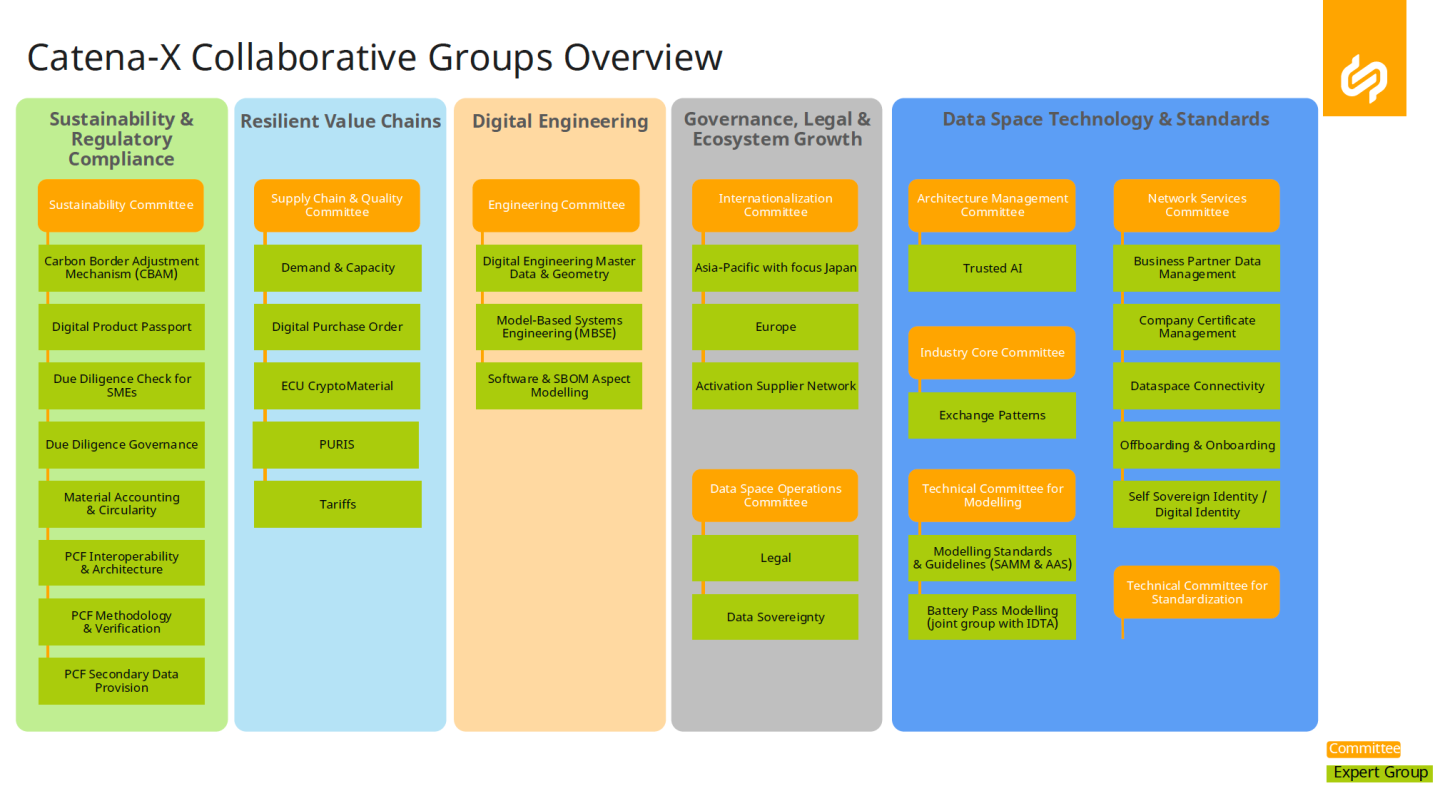
The Catena-X Association fosters knowledge exchange and collaboration among global corporations as well as small and medium-sized enterprises by establishing committees and expert groups that focus on specific subject areas. These groups play a crucial role in advancing the network and realizing shared objectives.
Expert Groups & Committees at Catena-X
Driving innovation and collaboration

Benefits of joining Expert Groups and Committees
By participating in an expert group or committee, members can contribute their expertise, help shape and refine standards, and actively influence the evolution of the Catena-X ecosystem. This not only supports personal and professional development but also promotes progress across the entire industry.
Our Committees and Expert Groups
Committees are specialized bodies appointed by the Board to address specific topics or tasks. Their mandate is to define the vision, mission, and roadmap within their respective domains. Expert groups are established by these committees to work on more targeted issues.
Each expert group focuses on a clearly defined topic with the goal of defining standards, refining methodologies, addressing regulatory requirements, and developing innovative solutions for productive use within Catena-X. Whether it’s enhancing the PCF rulebook, building digital product passports, or enabling secondary data provision – these groups bring theory and practice together.
At the core of their work lies open dialogue with members, external partners, and the open-source community Tractus-X. New groups are formed wherever emerging requirements, technologies, or regulatory frameworks demand collective innovation – always with the goal of driving the industrial transformation forward.
What follows is an in-depth overview of the current activities, results, and priorities of each expert group. We regularly share updates, new publications, and opportunities for involvement within the Catena-X ecosystem.
You can find an overview of our Committees and Expert Groups here:
All
Architecture Management Committee
Data Space Operations Committee (DSOC)
Engineering Committee
Industry Core Committee
Internationalization Committee
Network Services Committee
Sustainability Committee
Supply Chain & Quality Committee
Technical Committee for Modelling
Technical Committee for Standardization
Architecture Management Committee
Objective
The Architecture Management Committee (AMC) is the strategic nerve center for the technical evolution of the Catena-X data ecosystem. We translate bold business ambitions into a future-proof, scalable, and interoperable architecture— ensuring that technical decisions accelerate value creation across the entire value chain. As the single point of architectural truth, we align stakeholders, harmonize roadmaps, and set the guardrails that empower innovation while safeguarding consistency and trust. Our mandate is clear: make the Catena-X data space enterprise-ready, resilient, and open for growth.
Why the AMC Matters — Our Value Proposition
- From Strategy to Execution — We bridge the gap between boardroom strategy and technical reality, ensuring that architecture decisions directly serve business outcomes.
- Interoperability at Scale — We design for seamless integration — across use cases, across participants, and across initiatives like Manufacturing-X or IDSA.
- Lowering Barriers, Expanding Reach — Our architecture roadmap deliberately reduces complexity and entry barriers, making the data space accessible to SMEs and large enterprises alike.
- Decentralization by Design — We actively reduce dependency on central services, strengthening ecosystem resilience and participant autonomy.
- Architectural Integrity & Trust — Through transparent Architecture Decision Records (ADRs), quality reviews of standards and cross-committee governance, we ensure that every standard and every implementation follows a coherent blueprint.
Data Space Operations Committee (DSOC)
Objective
The DSOC is responsible for ensuring the smooth and efficient operation of the Catena-X data space from a governance perspective. It oversees processes, makes strategic decisions (e.g., release cycles, deployment gates), and continuously updates the operating model. The committee also collaborates with operating partners such as Cofinity-X and ensures interoperability with other data spaces to maintain a robust and future-proof ecosystem.
Current Status
- Ongoing improvement of the operating model
- Identifying solutions to operational challenges
- Developing proposals to enhance data space operations
- Managing the Deployment Gate process
- Ensuring compatibility with other data spaces
Engineering Committee
Objective
The Engineering Committee is the committee steering standardization and collaboration efforts across the engineering domain within Catena-X. Today’s engineering landscape faces significant challenges due to increasing complexity and fragmented data management: complex structures mean that even minor design changes can trigger extensive downstream impacts requiring time-consuming adjustments, while the involvement of multiple stakeholders introduces numerous interfaces with varying data formats. Frequent transformations risk data loss and delays — by the time data reaches its intended destination, it is often outdated, and further internal transfers compound inefficiencies, hindering real-time collaboration and seamless, integrated engineering processes.
Rather than implementing solutions directly, the committee oversees and steers efforts by establishing expert groups, aligning with related initiatives, and promoting the outcomes. Its mission is to act as the central hub for communication between Expert Groups, other association bodies, and external organizations — facilitating information flow, gathering cross-industry engineering requirements together with prostep ivip and other initiatives, promoting standardization with the Standardization Strategy Board and the VDA, aligning internal efforts across the business domain, and driving the international adoption of developed standards and best practices.
Current Status
For the implementation phase, initial use cases have been discussed and agreed upon. To realize them, three Expert Groups are being established: Masterdata, Software, and MBSE — each focusing on key areas essential for the successful execution of the identified use cases. Implementation and alignment with other initiatives are coordinated with Tractus-X.
Industry Core Committee
Refine the objectives and KIT related to the Industry Core to foster a productive use of the current standards and principles in the supply network.
Internationalization Committee
Objective
This committee is the driving force behind Catena-X’s global expansion. Its core responsibility is to initiate and establish new regional hubs around the world. Participation enables members to help shape the international rollout of Catena-X while deepening their understanding of global adoption strategies. It plays a highly representative role in strengthening regional industrial ecosystems.
Current Status
Over the past year, the committee focused intensively on North America, Spain, Sweden, Japan, and China. Highlights include:
- North America: Coordinated the IMDS/AIAG event, announced the launch of the North American hub, and led stakeholder engagements. The hub is now operational, with 30 actively participating companies.
- Spain: Established in cooperation with ANFAC and SERNAUTO, the Spanish hub has launched successfully and is supported by multiple local stakeholders.
- China: Developed a go-to-market strategy, launched key initiatives for Catena-X China operations, and established partnerships with local players. The group continues to refine the Catena-X concept for China and supports stakeholder delegations and industry meetups.
Network Services Committee
Our Objectives
Why the NSC Matters — Our Value Proposition
- ✅ Interoperability by Design — The NSC ensures all network services follow common standards and open interfaces, so any participant can connect and exchange data without lock-in.
- 🔐 Data Sovereignty — Every technical decision is guided by the principle that companies stay in control of their own data, aligned with EU regulations and international standards.
- 🌍 Regulatory Readiness — The NSC actively monitors and adapts to evolving EU legislation (e.g., data protection, cybersecurity, in-vehicle data regulations), keeping the ecosystem compliant and future-proof.
- 🚀 Innovation Enabler — By providing robust, open, and shared infrastructure, the NSC lowers the barrier to building new digital services and business models on top of Catena-X.
- 🤝 Cross-Industry Collaboration — The committee brings together members from across the automotive industry — OEMs, suppliers, technology providers, and platform operators — to co-create solutions that benefit the entire value chain.
- 📦 Open Source First — All reference implementations are developed as open-source software in Eclipse Tractus-X, maximizing transparency, reusability, and community-driven quality.
Sustainability Committee
Mission
The Sustainability Committee ensures that sustainability use cases align with the Catena-X vision and promotes industry-wide collaboration. It defines roadmaps and manages requirements for standards and toolkits such as the PCF and DPP. The committee coordinates expert groups, engages in external initiatives, and unites stakeholders across the automotive value chain to enable scalable, data-driven sustainability solutions.
Current Status
Together with the Sustainability Business Domain Manager, the committee coordinates and governs Catena-X’s sustainability domain, covering key use cases such as PCF, Circularity, DPP, and ESG. As the central steering body, it has introduced mentorship roles to ensure alignment between expert groups and the Catena-X Board.
As a strategic hub, the committee has launched several expert groups to further strengthen sustainability efforts within the Catena-X ecosystem. It actively involves relevant stakeholders, supports strategic partnerships—such as with AIAG—and has driven the establishment of new Catena-X hubs in Spain, Sweden, Shanghai, and North America.
Additionally, the committee represents Catena-X at industry events, promoting its vision externally. To keep initiative members informed, it hosts quarterly soundings covering current developments, roadmaps, and outlooks.
Contact: sustainability(at)catena-x.net
Supply Chain & Quality Committee
Objective
The Supply Chain & Quality (SCQ) Committee establishes a resilient, interoperable, and scalable data ecosystem for the supply chain and quality domains. Its objective is to enable predictable, high-quality data exchange that ensures uninterrupted product and material flows across the end-to-end supply chain. Its portfolio covers use cases such as DCM, PURIS, Product Approval, ECU CryptoMaterial, Field Quality Management, Block Notification, Special Characteristics, 8D, Warranty Data, and 0 km Failure — with the aim of positioning validated use cases as de facto industry standards.
Current Status
The focus has shifted from ideation and concept definition towards industrialization and impact delivery, concentrating resources on a reduced set of high-impact domains.
Review & Strengthen (Consolidation): existing use cases are systematically assessed and consolidated to increase maturity, reduce redundancy, and improve usability — prioritizing production-ready use cases with clear business impact, merging overlapping initiatives, and reducing fragmentation to strengthen interoperability.
Growing the Network (Scaling): for mature use cases, the priority is large-scale adoption — increasing the number of companies deploying use cases productively and onboarding additional software vendors, service providers, and platform integrators to enhance solution availability.
Success is measured by scaling, adoption, and measurable business impact: the transition from a portfolio of concepts to a high-throughput, production-grade data infrastructure.
Technical Committee for Modelling
Assure quality for semantic models before their formal standardization as a Catena-X and ultimately, as an IDTA submodel template.
Technical Committee for Standardization
Objective
The Technical Committee for Standardisation (TC4S) is the central body of the Catena-X Association for all standardisation matters and part of the governance structure within the Working Model. It acts as the central point in the standardisation process and as the gatekeeper for standard candidates before formal approval by the Executive Board — operating under strict compliance with the Operating Model, antitrust law, and IP regulations. TC4S safeguards the quality and consistency of every Catena-X standard by running the operational review layer and by involving the relevant Committees, Experts, and the Architecture Management Committee (AMC) for content review.
Current Status
TC4S is strengthening the standardisation process based on consolidated learnings and establishing proven best practices that balance quality, efficiency, and compliance. The Committee systematically assesses Standard Requests (SR) and Change Requests (CR), provides feedback and guidance to Expert Groups and Committees, and maintains the core quality foundations such as the Standard Quality Criteria Catalogue (SQCC) and the Guardrails for Normative Writing (GRNW). All quality criteria and gates are tested against real requests before they are formalized.
Objective
The Activation Supplier Network (ASN) is the central expert group driving supplier adoption across the Catena-X ecosystem. Its mission is to develop supplier participation into a decisive value driver by providing practical use cases, low-barrier entry points, and targeted engagement opportunities tailored to supplier needs. The ASN translates strategic goals into actionable initiatives — including assessment frameworks, guidance materials, and collaborative adoption models — to ensure supplier adoption delivers measurable impact across the value chain.
Current Status
In 2026, the ASN is conducting a dedicated workshop series for the most relevant Catena-X use cases. These workshops bring together suppliers and ecosystem partners to deepen understanding, co-develop narratives, and test guidance materials with real cases. In parallel, the group is developing reusable, modular materials — such as cost criteria catalogues, data sourcing options, and MVP paths — as well as a collaborative adoption model that enables structured partner support during the onboarding process. All components are continuously piloted and refined based on direct supplier feedback and market insights.
Objective
The APJ Expert Group drives the internationalization of Catena-X in Japan and South Korea. It brings together global and local members—automotive companies, IT providers, and institutions—to foster regional collaboration while respecting cultural and governance-specific differences.
Current Status
In Japan, Catena-X is building strategic alliances with institutional and industry stakeholders to align local data-sharing initiatives (e.g., Ouranos) with the Catena-X framework. Experts from both sides are working together to enable secure, efficient, and trusted data exchange between Japanese and European automotive actors.
In South Korea, the group is identifying further regional stakeholders to support the development of a hub comprising both industrial and institutional partners.
The group regularly organizes meetings, webinars, and workshops to promote Catena-X principles and value propositions across both regions, while also exploring potential synergies between Japan and South Korea.
Objective
This expert group is focused on establishing a global, cross-industry standard for Business Partner Data Management. It aims to enable a shared master data system for business partners based on data exchange principles. A central objective is the creation of a globally unique BPNL/S/A, serving as a foundation for Catena-X and other open data spaces.
Current Status
Currently, each company in the automotive supply chain manages its business partner master data independently, leading to data redundancy, high costs, and risks due to outdated data.
As of March 2024, the solution architecture is based on the BPDM Golden Record Process, ensuring data integrity and accuracy. BPDM standards and components are documented in the Catena-X Standard Library, while KITs and source code are available in the Eclipse Tractus-X BPDM KIT and Catena-X BPDM repository.
Key work areas include:
- Defining and maintaining the BPDM Golden Record Process, BPDM Gates, and Pools
- Standardizing and refining APIs to enable seamless integration
- Developing governance models for Value-Added Services (VAS)
- Aligning business requirements with the open-source community and related use cases
- Ensuring Gaia-X compatibility and alignment with evolving standards such as EDC
- Collaborating with other initiatives such as the Company Hierarchy Expert Group and related Catena-X use cases
This expert group plays a key role in delivering a harmonized, efficient, and scalable approach to business partner data across the Catena-X ecosystem.
BPDM Standards 1 BPDM Standrads 2 BPDM Standards 3 BPDM Standards 4
Objective
The Catena-X Expert Group for the Carbon Border Adjustment Mechanism (CBAM)is driving the standardization and automated exchange of CBAM-relevant emissions data within the Catena-X ecosystem. Its core tasks include transferring the CBAM KIT and the underlying CBAM data model — already developed within the CX-Next consortia — into the Catena-X Association’s governance and standardization process, as well as developing and releasing a formal Catena-X standard for CBAM data exchange.
The group ensures the interoperability of CBAM-certified solutions within Catena-X and aligns them with other relevant use cases (e.g. PCF, DPP, Industry Core) as well as external initiatives (e.g. Manufacturing-X, UK CBAM). In addition, it continuously adapts the data model and the KIT to evolving EU regulation (e.g. expanded goods scope, updated reporting requirements) and comparable international schemes.
Current Status
The group is working on enabling a standardized, decentralized data exchange between EU importers and non-EU suppliers via the Catena-X network, using structured request and response notifications. This covers both ongoing data collection during the import year (supplier identification, forecasting, certificate purchase) and period-closing emissions data collection (verified actuals for annual CBAM declarations).
In parallel, the Tractus-X KIT and the data model are being further developed, and alignment with other relevant Catena-X use cases such as PCF, DPP, and Industry Core is being advanced to ensure a coordinated and scalable approach to CBAM data exchange across the industry.
Objective
This expert group aims to simplify the provision and exchange of company certificates. By developing a standardized API and data model, the group provides a reliable and efficient solution that improves the accuracy and usability of company certificates across the Catena-X ecosystem.
Current Status
To achieve this, the group has developed a standardized data model (CX-0135) that allows companies to provide and exchange certificates within the Catena-X data space. This model uses the Business Partner Number (BPN) as the primary identifier to ensure seamless certificate-to-entity mapping.
Key work items:
- Refinement of the CX-0135 standard
- Alignment of the certificate management framework with Industry Core requirements
- Enabling certificate exchange along the value chain
- Definition of an architecture for certificate provision and clarification of push vs. pull mechanisms
- Establishment of notification procedures for certificate updates and expirations
- Updating the semantic model based on evolving business needs
- Implementation of certificate versioning mechanisms
- Definition of validation methods such as OCR, AI-based validation, and trust levels
- Harmonization of validation criteria for different certificate types
- Extension of the verified certificate list (e.g., ISO 9001)
- Execution of KIT tests with selected partners and solution providers
- Engaging market participants to activate solution providers for broader adoption
Objective
This expert group ensures that communication between participants in the Catena-X data ecosystem meets the requirements for interoperability and data sovereignty. It defines how participants should interact, which transmission profile types to use, and how to integrate credential services to ensure compliance with policy requirements and data record conventions.
Current Status
The group actively manages Catena-X requirements towards upstream projects, aligns specifications within Eclipse Tractus-X, and defines the CX-0018 standard. It collaborates with other expert groups (SSI, Industry Core, Data Sovereignty) to advance data space technologies.
The central technical component, the connector, is implemented in the Tractus-X ecosystem to enable data space connectivity. The group monitors the development of the Tractus-X EDC to ensure alignment with the Network Services Committee roadmap.
Regular meetings have been established. Current initiatives include defining policy requirements, improving interoperability, and refining the CX-0018 standard.
GitHub Repository Relevant Standards 1 Relevant Standards 2 Roadmap & Planning
Objective
The Catena-X DCM Expert Group focuses on maintaining the Demand and Capacity Management (DCM) standard and further developing the DCM KIT. Its main objective is to improve the scalability of the DCM use case, which aims to jointly identify potential supply bottlenecks at an early stage. This proactive approach ensures practical applicability, business value, and seamless integration across different applications (freedom of choice).
Current Status
The DCM use case is mature and based on a stable, implemented standard and a fully developed KIT. The current focus is on keeping the solution stable while supporting activities that enable scaling, broader adoption, and efficient operational rollout.
Mission
The automotive industry faces growing challenges such as emission reduction, increased recycling, and improved circularity. This expert group focuses on developing Digital Product Passports (DPPs) to make product life cycles—starting with batteries—digitally traceable.
Key topics include stakeholder collaboration, data security, and standardization to enable transparency and sustainability. Through close cooperation among manufacturers, recyclers, and policymakers, Catena-X is accelerating innovations for a circular economy and the widespread adoption of DPPs.
Current Status
The group has published a whitepaper titled “Digital Product Passports as Enablers for the Circular Economy,” outlining how DPPs fulfill three core functions: consolidating product data in a digital tool, meeting regulatory and sustainability requirements along the value chain, and enabling circular business models. DPPs support transparency, recycling, reuse, maintenance, and regulatory compliance in the automotive sector.
The group is currently conducting a gap analysis and updating the generic DPP data model to align with current regulations such as the ESPR, ELV, and other directives. Additionally, it is developing a robust framework for “data verification and validation” to ensure trustworthy data and enable informed decision-making.
Further areas of focus include enhancing the scalability and functionality of DPPs. The group also oversees the Eco Pass KIT on Tractus-X to ensure alignment and ongoing development.
Objective
The Digital Purchase Order Expert Group transfers the existing VDA recommendation for the digital exchange of framework agreement data into the Catena-X ecosystem, operating under the Supply Chain & Quality Committee. Today, operational data related to framework agreements is largely exchanged via paper documents or unstructured PDF files — often 100 pages or more, distributed by batch e-mail or manual download from OEM portals, and captured manually or semi-automatically on the supplier side via OCR or handwriting recognition. As framework agreement data such as prices and conditions is updated at least annually and frequently several times per year, millions of price and condition updates per OEM-supplier relationship are processed each year. Customer-specific documents and varying layouts add further complexity, resulting in high administrative overhead, inconsistent data structures, limited automation, and reduced data transparency.
The group’s mission is to establish a Catena-X standard for the transmission of structured framework agreement data — increasing efficiency and scalability, improving data quality and consistency, enabling automated downstream processing of operational purchasing data such as P-material purchase orders, and providing procurement as data owner with a standardized, interoperable, and future-proof exchange option.
Current Status
Building on the finalized VDA recommendation — including a syntax-neutral data model and an XML-based technical specification — the Expert Group focuses on integration, governance, and technical enablement within Catena-X. The tasks are to transfer the VDA standard into the Catena-X ecosystem, define it as an optional standardized data transmission path, and develop a Catena-X compliant use case and technical implementation concept. Deliverables are a Catena-X Standard and a Tractus-X KIT.
The substantive and data-model-related discussions have already been concluded within the VDA. Accordingly, redesigning the VDA standard, duplicating standardization effort, defining commercial or contractual terms, and OEM- or supplier-specific customization are explicitly out of scope — the standard remains generic and interoperable.
Objective
Current Status
The Due Diligence Check Expert Group is standardising sustainability due diligence across companies to reduce fragmented, manual processes and enable interoperability through Catena-X. Its approach follows a “healthcare analogy”: structured indicators such as country, industry and company risk determine the appropriate level of due diligence, using defined thresholds and follow-up measures.
The group is developing a standardised framework aligned with CS3D requirements, combining country and industry risk registers with risk-based decision trees. Existing due diligence instruments, including SAQs, audits and assessments, are being integrated into a unified system to avoid duplication and reduce the compliance burden for suppliers, particularly SMEs. An initial KIT (Keep It Together) was released in March 2026 as the foundation for further development and will evolve through iterative releases into a comprehensive rulebook supporting future services and software solutions within the ecosystem.
To ensure regulatory and legal robustness, an Advisory Board has been established with representatives from the European Commission, Friedrich Alexander University and the German Institute for Human Rights. Nine documents comprising around 300 pages have been submitted for expert review, with a second review cycle planned later this year. Meanwhile, the country risk register scoping analysis is around 90% complete, while industry risk modelling will continue over the next 12–18 months. Work is also progressing on evaluation grids to determine which due diligence instruments are appropriate under specific risk conditions.
A software implementation roadmap is emerging around three core areas: standardised data input, including PPN and employee data; a risk assessment and scoring engine; and the integration of SAQ, audit and compliance tools. Initial software implementation is targeted for next year, including alignment with existing providers such as EcoVadis. Looking ahead, the group is also exploring extension into deeper supply chains and alignment with UNTP frameworks. The long-term objective is a scalable, interoperable due diligence system integrated into Catena-X that reduces compliance effort while ensuring comprehensive regulatory coverage.
Objective
The Catena-X Expert Group on Due Diligence Governance (DDG) is dedicated to further developing environmental and human rights compliance requirements within supply chains. Its mission is to identify regulatory gaps, define priority areas for development, and provide practical guidance for Catena-X members.
Through collaboration with external initiatives, member feedback, and exchange with ESG experts, the group will evolve existing standards, the ESS Kit, and pragmatic best practices. It also supports continuous updates and coordinates closely with the Tractus-X open-source community.
Current Status
The Due Diligence Governance Expert Group is currently being established. Stay tuned—updates and initial results will be published here soon.
Data Sovereignty Expert Group
The Data Sovereignty Expert Group within Catena‑X is responsible for ensuring that data sovereignty remains a foundational and consistently applied principle across the Catena‑X Data Space. The expert group provides a permanent governance and development structure to further evolve, operationalize, and communicate data sovereignty concepts within the ecosystem. Through its work, the Data Sovereignty Expert Group safeguards equal participation, non‑discrimination, and full control over shared data for all Catena‑X members.
Scope
The expert group acts as the central body for:
- Governing and maintaining the Data Exchange Governance framework, including contractual foundations.
- Consolidating business, legal, and technical data sovereignty requirements across Catena‑X.
- Translating data sovereignty principles into standards, policies, and enforceable constraints within the Catena‑X ecosystem.
-
Coordinating closely with other committees and expert groups, notably regulatory, architecture, operations, and standardization bodies.
Key Objectives
- Ensure the continuous maintenance and evolution of the Catena‑X framework agreement on data exchange governance.
- Further develop the Catena‑X Open Digital Rights Language (ODRL) Profile as the technical backbone for data usage control.
- Define, align, and extend modular contract components covering data sovereignty constraints.
Objective
The Expert Group aims to improve cross-company engineering processes by enabling digital master data management across the value chain. It focuses on sharing comprehensive engineering and 3D master data via Catena‑X to support design, validation, homologation, and sustainability use cases such as Digital Product Passports and Digital Bills of Process. Dedicated digital collaboration spaces integrated with Catena‑X technologies ensure transparent and sustainable cooperation throughout the product lifecycle.
Current Status
The Expert Group has developed the relevant aspect models and released the first version of the corresponding standard. Current activities focus on collecting feedback from initial adoption and real-world usage, and on refining the aspect models and/or the standard as needed to ensure robustness, applicability, and broader adoption across the ecosystem.
Objective
The objective of the expert group is to establish a standardized approach for the exchange of cryptographic information related to Electronic Control Units (ECUs). This includes enabling reliable verification of ECU authenticity and supporting secure access to protected debugging and development functions through a unified, interoperable data format across the automotive ecosystem.
Current Status
The expert group has developed the relevant aspect models and released the first version of the corresponding standard. Current activities focus on collecting feedback from initial adoption and real-world usage, and on refining the aspect models and/or the standard as needed to ensure robustness, applicability, and broader adoption across the ecosystem.
Objective
The Europe, Middle East, and Africa (EMEA) Expert Group is the expert group driving the international expansion of Catena-X across the EMEA region as part of the Internationalization Committee. EMEA is a key pillar for this expansion, characterized by a high concentration of automotive players, established industry structures, and a growing number of initiatives related to data spaces and digital supply chains — while remaining highly heterogeneous in terms of regulatory environments, market maturity, organizational structures, and readiness to adopt Catena-X standards and governance models. The group’s mission is to build a scalable, coherent, and industry-oriented Catena-X Hub network that combines strong regional anchoring with effective global collaboration, positioning Catena-X Hubs as the primary local point of contact for industry partners with questions related to Catena-X adoption.
Current Status
The Expert Group focuses on three core tasks that are essential for the sustainable scaling of Catena-X in the region. First, it identifies suitable partner organizations and actively supports the foundation of new Catena-X Hubs across EMEA — including the evaluation of potential partners, clarification of roles and expectations, and guidance through the onboarding and setup phase in close alignment with Catena-X governance and operating models. Second, it strengthens existing hub partnerships through continuous engagement, structured exchange, and targeted enablement, supporting hubs at different stages of maturity in fulfilling their role as sustainable, long-term multipliers of Catena-X while ensuring consistency and quality. Third, it enhances global collaboration between hubs: rather than operating as isolated regional entities, hubs are connected more closely across regions to form a lively and effective global hub network that facilitates knowledge sharing, best-practice exchange, and joint activities, while ensuring alignment on messaging, standards, and governance.
Mission
Current Status
Mission
The Legal Expert Group is responsible for developing and maintaining the legal framework of Catena-X, with a particular focus on the altitude layer model (“Flughöhenmodell”) and the legal rules governing data exchange within the ecosystem.
The group ensures that legal requirements are consistently translated into clear, enforceable rules for data sharing, usage rights, and contractual structures across all layers of the Catena-X architecture. This includes defining harmonized approaches for data access, sovereignty, liability, and compliance.
By closely collaborating with internal expert groups and external initiatives, the Legal Expert Group enables legally compliant, secure, and scalable data exchange, while ensuring alignment between legal, technical, and operational perspectives.
Its work provides the foundation for trust, interoperability, and reliable collaboration across the Catena-X ecosystem.
Current Status
The Legal Expert Group is actively working and has already established key elements of the Catena-X legal framework. This includes a structured legal framework as well as a modularized contractual approach supporting standardized and scalable data exchange.
The current focus lies on further refining the legal framework, enhancing the alignment with the altitude layer model (“Flughöhenmodell”), and continuously adapting the contractual modules and data exchange rules in line with evolving requirements and implementations.
Learn more: https://catenax-ev.github.io/docs/regulatory-framework/governance-framework
Mission
The transition towards a circular economy requires efficient collaboration between OEMs, dismantlers, recyclers, and downstream material processors. Today, the end-of-life value chain remains highly fragmented, with limited digital integration and a lack of standardized data exchange. The Material Accounting & Circularity Expert Group develops and validates standards, data models, and digital solutions that enable transparent material flows, reliable circularity claims, and scalable end-of-life processes — addressing how recyclates can become more available and economically viable, how quality, traceability, and trust in secondary materials can be ensured, and how companies can meet growing regulatory requirements without greenwashing risks.
The group supports emerging circular economy strategies and regulations, in particular the End-of-Life Vehicles (ELV) Regulation, through standardized material information, circularity passports, mandatory dismantling information, and certificates supporting circularity and recovery claims. By enabling standardized and automated access to regulatory-relevant information, it reduces administrative effort and compliance costs, strengthens brand protection and traceability, lowers transaction costs, and creates growth opportunities for end-of-life ecosystem participants — ultimately increasing the availability, quality, and affordability of recyclates.
Current Status
The Expert Group brings together previously independent expert communities into a single group to strengthen collaboration, accelerate implementation, and create a unified approach towards a data-driven circular economy. Work has started along two workstreams:
1. Industrialization and Strategic Stakeholder Engagement for the Material Accounting Standard — supporting ongoing app development for adoption, continuously enhancing the Material Accounting Standard CX-0159, its KIT and data model through technical and operational pilots in real-life environments, defining a value proposition for larger industrialized dismantlers, supporting VDA collaboration to establish Material Accounting as an industry standard, aligning process and data requirements for the data exchange with IMDS, and driving adoption through use case representation at fairs and events.
2. Enablement of Circularity, Data-Driven Recycling and End-of-Life Services — developing a value proposition for data-driven dismantling, recycling, and material recovery, designing a concept to aggregate materials and components from small dismantlers via logistics and software providers (e.g. Hub & Spoke) within Catena-X guardrails, reaching out to associations such as BVSE, identifying and validating processes and data requirements including the assessment of data sources such as IMDS, collaborating with initiatives such as Manufacturing-X, ReDriveS, and EDCar, and evaluating and updating the Circularity Core Standard CX-0131 and its KIT.
Objective
The Expert Group aims to foster multi-stakeholder collaboration in the development of vehicles and their subsystems within the Catena-X data ecosystem. The goal is to enable companies to jointly apply Model Based Systems Engineering (MBSE) while maintaining data sovereignty. By improving traceability across the ecosystem, the work package also sets the foundation for enhanced functionalities, such as advanced analytics based on shared information.
Current Status
The Expert Group has developed the relevant aspect models and released the first version of the corresponding standard. Current activities focus on collecting feedback from initial adoption and real-world usage, and on refining the aspect models and/or the standard as needed to ensure robustness, applicability, and broader adoption across the ecosystem.
Objective
This expert group addresses key challenges in onboarding and offboarding processes within the Catena-X ecosystem:
- Inefficient onboarding processes: Companies joining the network experience delays and confusion due to a lack of standardized workflows.
- Unstructured offboarding procedures: The absence of transparent, legally compliant exit processes creates potential security risks, data privacy concerns, and legal conflicts.
- Lack of interoperability: Different onboarding service providers operate without harmonized standards, hindering cross-network collaboration.
Solution Approach
To improve efficiency and ensure legal compliance, the expert group is working on:
- Defining clear onboarding and offboarding procedures
- Implementing system-supported processes for seamless enterprise integration and transparent exit routines
- Enhancing network security through defined rules for managing company data
- Building trust and ensuring regulatory compliance by aligning processes with Catena-X governance standards
- Coordinating closely with the Eclipse Tractus-X Community Identity Hub (DCP) and portal teams
Objective
The Catena-X Expert Group for PCF Interoperability and Architecture is driving efforts to ensure the technical interoperability of PCF solutions within the Catena-X ecosystem. Its core tasks include updating and further developing the PCF exchange standard CX-0136 and the underlying PCF data model, aligning PCF applications with evolving Catena-X standards, and coordinating PCF-relevant technical and architectural concepts across sustainability use cases.
The group ensures interoperability within PCF, across other Catena-X use cases (e.g. CBAM, DPP), and with relevant external initiatives (e.g. WBCSD PACT, TfS, Manufacturing-X) — while safeguarding compliance with the evolving calculation methodology defined in the Catena-X PCF Rulebook.
Current Status
The group is actively identifying, prioritizing, and monitoring interoperability weak spots between Catena-X certified solutions within single use cases. In parallel, it is setting up test cases to support interoperability testing for both existing and new solution providers, and proposing measures to overcome identified interoperability issues.
Additionally, the group is investigating and evaluating technical concepts and solution options to prepare recommendations for implementation and standardization. Updates and releases of use-case-specific KITs and standards (e.g. PCF KIT, CX-0136) are carried out jointly with the relevant use-case-specific expert groups, ensuring a coordinated and scalable approach to PCF data exchange across the industry.
Objective
The Expert Group on PCF Methodology and Verification ensures the ongoing development of the recognized Product Carbon Footprint (PCF) rulebook, enabling credible and comparable CO₂ footprint calculations. Key tasks include methodological advancement, alignment with regulatory requirements, integration of relevant initiatives (e.g., GBA, WBCSD), and regular updates to the rulebook based on community feedback.
The group is also responsible for the verification and certification of PCF data—an essential step toward credibility and the promotion of sustainable practices within the Catena-X ecosystem.
Current Status
The expert group has launched a dedicated sub-group focusing on PCF in electronics to analyze this domain and enhance the existing rulebook if necessary. In parallel, another team is developing a concept for providing secondary data.
Version 3.1 of the PCF rulebook was recently released alongside the March 25th system update. Preparations for version 4.0 are already underway.
Following the publication of the Catena-X verification framework, a dedicated workstream is focused on the topic of verification. This includes the development of a nomination process for verification bodies to integrate future auditors and bring the framework into practice.
Objective
The Catena-X Expert Group for PCF Secondary Data Provisioning is driving efforts to boost PCF reporting across the automotive supply chain. Its core tasks include defining relevant data types (materials, processes, energy sources), developing mapping rules, and establishing approximation methods for calculating PCFs in complex products.
The group is compiling initial datasets and developing procedures for regular data updates. It aims to close existing data gaps by ensuring easy access to secondary data—while maintaining comparability and traceability for all Catena-X participants.
Current Status
The group has achieved major progress in advancing PCF reporting for the automotive sector. Following a targeted outreach to Catena-X members, it received important input regarding secondary data requirements.
It is currently collecting data and building a comprehensive repository based on this feedback. In parallel, the group is evaluating whether to develop its own database or connect with external providers to streamline access and integration.
The objective is to align data collection with member-specific needs and enable efficient, accurate, and scalable PCF reporting across the industry.
Objective
This expert group focuses on handling additional information needed to automate informed decision-making in cases of potential and actual supply disruptions. Its main workstreams include:
- Implementing and securing existing standards
- Rolling out n-tier processes that automate data exchange and enhance the flow of beneficial information across the supply chain
- Developing and implementing new standards and functionalities based on industry needs
Current Status
PURIS is being brought into active use through targeted promotion at events and the systematic collection of external feedback. In parallel, the PURIS FOSS application is being enhanced to serve as a solid basis for future SaaS offerings and self-hosted deployments. Initial success stories are being built to demonstrate value and drive broader adoption.
Mission
The Self-Sovereign Identity (SSI) / Digital Identity Expert Group defines and continuously evolves the identity architecture of Catena-X in alignment with emerging trust frameworks across various global regions, such as the European Business Wallet. The group guides the ongoing transition from a Catena-X-specific digital identity architecture towards integration with overarching, external trust infrastructure. Key focus areas include positioning Catena-X within the European identity ecosystem (eIDAS 2.0, EUDI, EBW), advancing the trust model from a single trust anchor towards a federated approach, and ensuring interoperability with participants’ existing enterprise identity infrastructure.
Scope & Responsibilities
The group owns, maintains, and further develops the core identity standards of Catena-X — CX-0049 (DID Document Schema), CX-0050 (Framework Agreement Credential), CX-0149 (Dataspace Identity and Identification), and CX-NFR-IdP(Identity Proofing). Its recurring areas of work include:
- Evaluating and refining the identity proving process, including the role of external clearing house dependencies.
- Evolving the SSI architecture to allow multiple roles to issue, hold, and verify verifiable credentials.
- Keeping identity data models and protocols up to date (e.g. the W3C Verifiable Credentials Data Model).
- Leading the integration of overarching trust architectures such as EU Business Wallets and EU Company Credentials.
Objective
The objective of this Expert Group is to enable software‑related use cases in the Catena‑X ecosystem by providing a standardized Software Bill of Materials (SBOM) based on SPDX as a foundational capability. As a first step, the focus is on establishing the reliable provision and exchange of SBOMs across the supply chain. Building on this foundation, the SBOM is then used to support regulatory compliance use cases, with an initial emphasis on meeting U.S. ICTS (Information and Communications Technology and Services) requirements.
Current Status
The aspect model and the corresponding SBOM standard have been released and are available for use in the Catena‑X ecosystem. The current focus is on building the ICTS compliance use case based on the provided SBOM capability. In parallel, the Expert Group is identifying and prioritizing additional potential use cases that can leverage SBOM data in the future.
Objective
The objective of the Tariffs Expert Group is to develop and govern a harmonized approach for the exchange of tariff‑relevant information within the Catena‑X ecosystem. The group focuses on enabling automotive OEMs and suppliers to securely and efficiently share data required for U.S. tariff declarations—particularly for parts containing steel and/or aluminium—while ensuring alignment with regulatory requirements such as Section 232. To ensure industry acceptance and consistency, the work of the expert group is carried out in close alignment with the Automotive Industry Action Group (AIAG).
Current Status
The expert group has developed the relevant aspect models and released the first version of the corresponding standard. Current activities focus on collecting feedback from initial adoption and real-world usage, and on refining the aspect models and/or the standard as needed to ensure robustness, applicability, and broader adoption across the ecosystem.
Objective
The Trusted AI Expert Group is a newly established group under the Catena-X Architecture Management Committee, tasked with laying the foundation for responsible, transparent, sovereign, and auditable AI use across the automotive data ecosystem. Its core objective is to define Catena-X-specific rules, architecture patterns, and standards enabling AI services to be registered, discovered, contracted, and governed across organizational boundaries, while ensuring compliance with legal frameworks. Key deliverables include a minimal Trusted AI asset model, policy and semantic specifications for cross-company AI usage, and conformity assessment criteria to be integrated into the AI Service KIT. The group will address collaboration patterns such as distributed learning, distributed inference, multi-agent interaction, policy-governed AI execution, and ecosystem intelligence.
Current Status
The expert group is in its formation phase, actively recruiting 10–15 members (plus a lead and co-lead) from OEMs, suppliers, SMEs, and technology providers, with a kick-off scheduled for September 2026. Key milestones follow shortly after, including the initial AI scope definition (12/2026), trust model and first CX AI standard (03/2027), and regulatory-aligned controls (12/2027).
Get in touch!

Get in touch with us and learn about the benefits of Catena-X!
We warmly invite newcomers to our monthly Catena-X information webinar. Register now!
Read moreCatena-X State of Network Report
Catena-X network grows by more than a factor of five to over 1000 companies.
Five years after its founding, Europe’s industry-governed automotive data ecosystem is establishing the shared ‘trust layer’ for an industry-wide digital twin and industrial AI.